
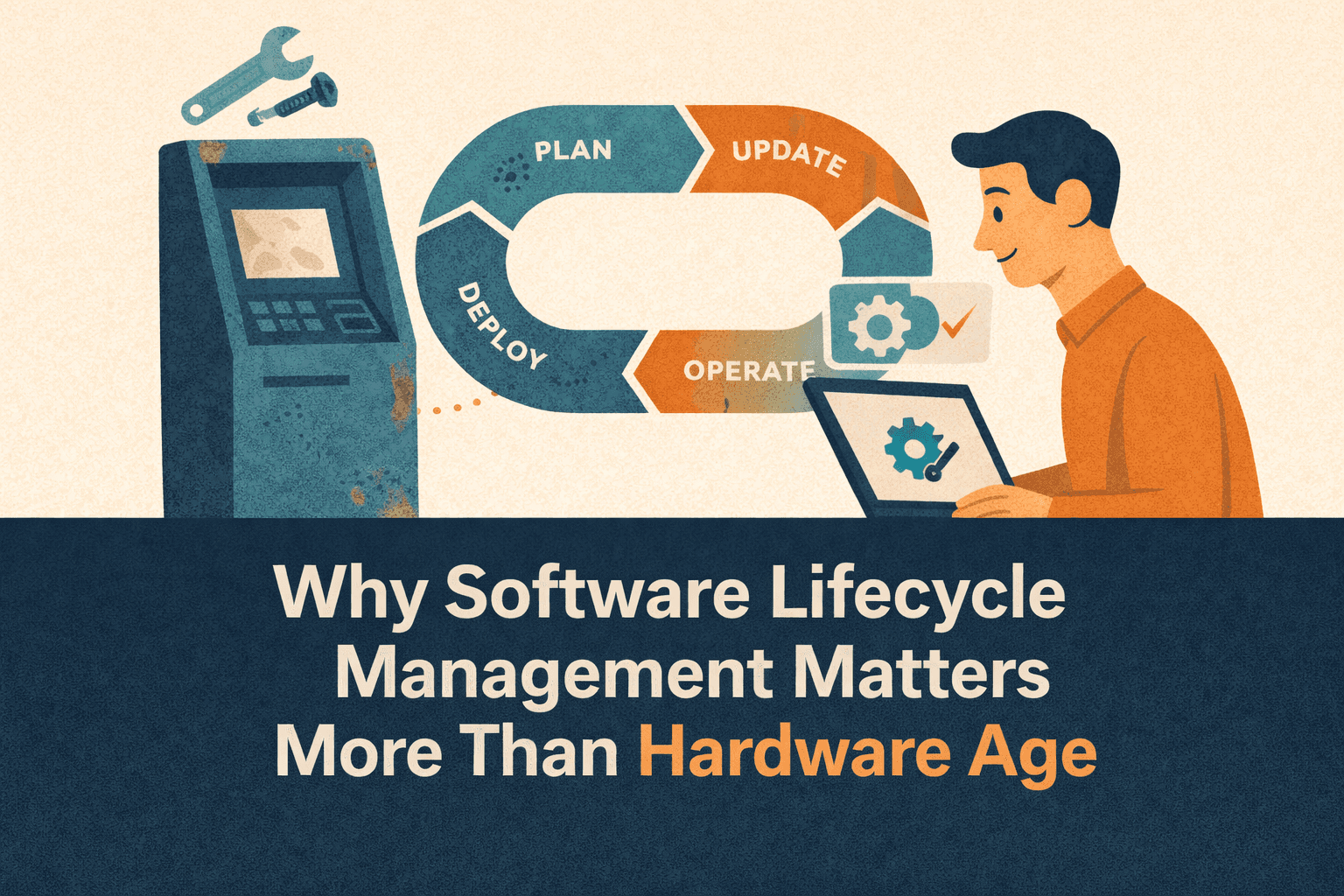
In many ATM organizations, modernization discussions still start with the same question: How old is the hardware?
While hardware age is easy to measure, it is no longer the decisive factor for stability, security, or availability. In practice, software lifecycle management has become far more critical than the physical age of an ATM.
For operators managing large or long-lived fleets, this shift has significant operational and financial implications.
Hardware ages slowly. Software risk grows fast.
ATMs are designed for longevity. It is not unusual to see devices in the field for ten years or more, mechanically sound and fully capable of processing transactions. Hardware failures tend to be gradual, predictable, and often isolated to specific components.
Software behaves differently.
Operating systems, drivers, middleware, ATM applications, and security components are constantly exposed to:
newly discovered vulnerabilities,
changing regulatory requirements,
dependency conflicts,
compatibility issues after updates or patches.
An ATM with “young” hardware but outdated or poorly managed software can be far more fragile than an older device running a well-maintained software stack.
Availability is driven by software state, not device age
Many availability issues attributed to “old ATMs” are, in reality, software lifecycle failures:
inconsistent software versions across the fleet,
missing security patches,
outdated drivers interacting poorly with newer components,
undocumented configuration drift over time.
These issues increase incident frequency, complicate root cause analysis, and lead to unnecessary technician dispatches. From an operational perspective, the software state of the ATM determines whether it is stable, predictable, and recoverable.
This is why operators increasingly focus on questions like:
Do we know exactly which software versions are running where?
Can we update, roll back, or reconfigure remotely?
Are lifecycle stages clearly defined and enforced?
Lifecycle management enables controlled modernization
Replacing hardware is expensive, disruptive, and slow. Software lifecycle management enables a different approach: incremental modernization without hardware replacement.
A mature lifecycle strategy includes:
standardized software baselines,
controlled rollout of updates and patches,
automated distribution and validation,
clear end-of-support policies,
continuous monitoring of software health.
With these elements in place, operators can extend the useful life of existing hardware while still meeting security, compliance, and availability requirements.
In other words, software lifecycle management decouples innovation from hardware refresh cycles.
Security and compliance depend on lifecycle discipline
From a risk perspective, unmanaged software is a larger threat than aging hardware. Regulators, auditors, and security teams increasingly focus on:
patching cadence,
documented update processes,
auditability of software changes,
response time to critical vulnerabilities.
Without disciplined lifecycle management, even modern ATMs can quickly fall out of compliance. Conversely, older devices can remain compliant and secure when software updates are controlled, timely, and verifiable.
Operational cost follows software maturity
There is also a direct cost dimension. Poor lifecycle management leads to:
higher incident volumes,
longer mean time to repair,
more 3rd-level support involvement,
avoidable site visits.
Well-managed software reduces operational noise. Known issues are handled predictably, updates are planned instead of reactive, and support teams spend less time firefighting.
Over time, this has a greater impact on total cost of ownership than the age of the hardware itself.
Conclusion
Hardware age is visible, but software lifecycle health is decisive.
ATM networks fail, degrade, or become expensive to operate not because devices are old, but because software is unmanaged, inconsistent, or outdated. Operators that invest in disciplined software lifecycle management gain stability, security, and flexibility, regardless of how long their hardware has been in the field.
In modern ATM operations, the question is no longer “How old is the machine?”
It is “How well is its software lifecycle controlled?”